
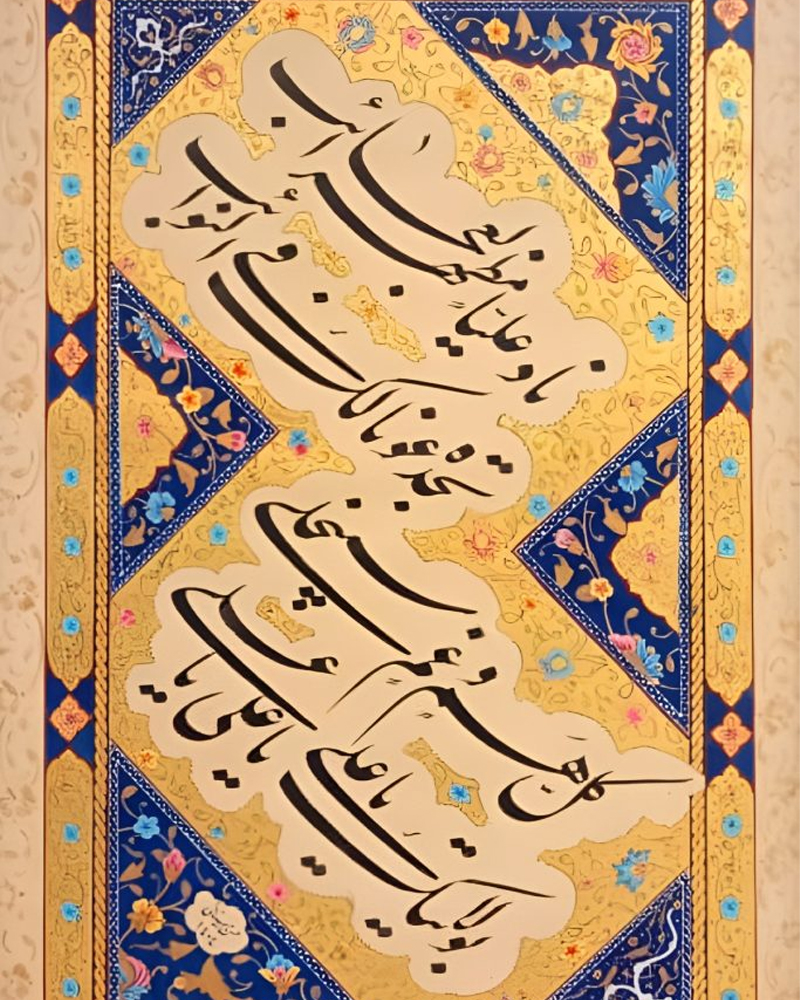
It is the art of written works, including oral discourses. Fatimi Ismaili Du’at introduced a new term “Al Adab al-Fatimi” to the devoted Literature which starts from the era of the Ibrahimi Imam, Moulana Al Imam Abd al-Mutallib (as), the grandfather of Rasulullah (S). Like other literature, Al Adab al-Fatimi or Fatimi Literature doesn’t deal with vulgar discussion, poetry and prose. Its core purpose is to lead towards divine liberation or Naj’at. Hadith, Kalam of Amir al-Muminin Ali (as), “Sahifah Alaviyyah”, “Sahifah Kamilah Sajjadiyyah”, Adiyyah Muayyidiyyah, Munajat, Naat, Manqabat, Marthiyah, Qasidah, Salaam are its few unique features. The core purpose of this literature is Tafsir and Tawil of the Qur’an, employing a meaningful approach according to the needs of the time. Its aim is not restricted to gaining appreciation from the audience, but to preserve the rays of Noor – divine light for the guidance of future generations. Ahl al-Bayt (as) or Masumin spent their lives spreading Haq, and accepted Shahadat for the sake of Islam. This devotional literature discusses their merits and significance along with their Ta‘lim. Moreover, it emphasizes how a person should ponder on and practice good deeds “Amr bil Maruf” whilst abstaining from disobedience “Nahy an al-Munkar” in all circumstances. The most beautiful aspect of this literature is that it can be discussed in any language, place, and period.
Another meaning of al-Adab is the religious etiquette that precedes and, in practice, safeguards the religion itself; hence the dictum:
“Adab al-Deen Qabl al-Deen.”
In Ismaili philosophy, it is read as: ethical and spiritual discipline is the threshold to true religion. Adab refines the Nafs, aligns one’s Zahir (outward conduct) with one’s Batin (inner reality), and makes ‘ilm and ‘ibadah spiritually effective; without it, religion risks becoming mere form or argument. Practically, it means reverence, humility, service, and disciplined conduct under the Imami Hidayah are what prepare a person to receive and live the Deen. Adab is the ability to unite and link one object to another, such that the linkage reflects an ideal state of affairs. Adab in one light means to call someone towards building good character – Akhl’aq Fadilah. Adab can also be understood as a way in which to effectively convince someone. Qu’ran al-Majid is the greatest composition of Adab as it encapsulates knowledge of all creation whilst reflecting on how all creation is connected. Qur’an itself is the highest Adab which Allah has granted. The essence of the Qur’an’s Adab is its ability to unite and link one thing to another. Every Surah of the Qur’an is linked to the next; each Ayah is connected to the next; each word is linked to its meaning; what is Zahir is linked to its Batin. Awliya (ra) have taught us the codes of conduct and Adab of Qur’an that are also the etiquettes of Islam and Im’an, and in doing so, united us. In other contexts, Adab takes the form of literature, in prose and poetry.
To see more articles, please scroll down