
Law is a system of rules and guidelines institutionalized for molding the political, economic and social systems. Legal systems elaborate rights and responsibilities in a variety of ways. In this modern world, each country has its constitution which is its supreme law. The legislature lays the way for ethical behavior, thereby establishing rights and responsibilities of the constituents of a society
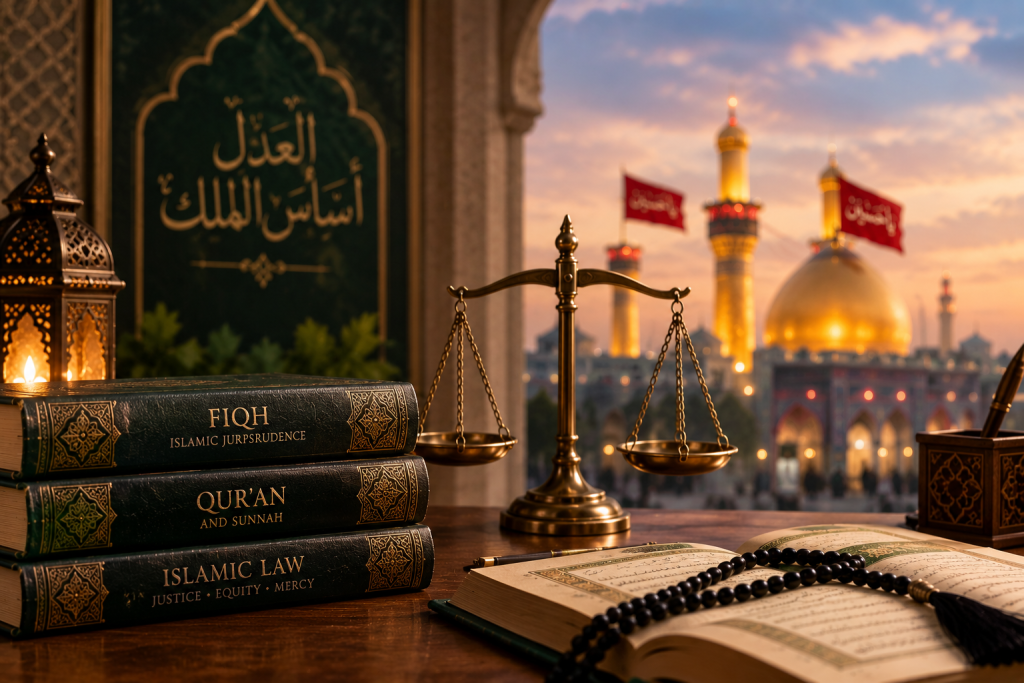
Law is a system of rules and guidelines institutionalized for molding the political, economic and social systems. Legal systems elaborate rights and responsibilities in a variety of ways. In this modern world, each country has its constitution which is its supreme law. The legislature lays the way for ethical behavior, thereby establishing rights and responsibilities of the constituents of a society, complemented with appropriate condemnations to ensure compliance. Furthermore, the philosophy behind punishment is teaching a lesson and creating fear amongst the masses to ensure that they refrain from committing crimes. Enforcers of law include Courts, Judiciary, Judges, Ombudsman, and Qadi. Fiqh, or Jurisprudence, teaches us the underpinnings of the Shariah. It educates on what Allah and His Rasul (S) pronounce and how His Ahl al-Bayt (as) explain it as per the need of the time without any alteration. Fiqh shows us the difference between right and wrong, clean and unclean, and Halal and Har’am, thus enabling us to live our best selves in accordance with Shariah, the divine Law. The knowledge of Shariah draws from multiple subjects – sciences, commerce, technology, geography, history, literature, arts, and law to name a few.
Despite all the advancements in space studies, mathematics, and physics, no ordinary human being has or will ever be able to calculate and decipher how human beings become spiritual beings and then ascend to Jannah. The root of all sciences and the base of Fiqh is Hidayah given by Muhammad (S) and his ‘itrat Tahirah (as). Without this source of Hidayah, no one can receive Najaat. Fiqh is Islamic Jurisprudence and an expansion of the Shariah Law based directly on the Qur’an and Sunnah that complement Shariah with evolving rulings/interpretations from the Islamic jurists. Fiqh deals with the observance of rituals, morals, and social legislation in Islam. There are four prominent Sunni schools: Hanafi, Shafa’i, Maliki, and Hanbali. There are two leading schools within the Shias, Ithna Ashar and Ismailis. Ismailis are again divided in two branches: Nizaris and Tayyibis. Tayyibis are again subdivided into two major branches, Dawoodis and Sulaymanis, while third Alavis are a cult of only 6000 people.
To see more articles, please scroll down